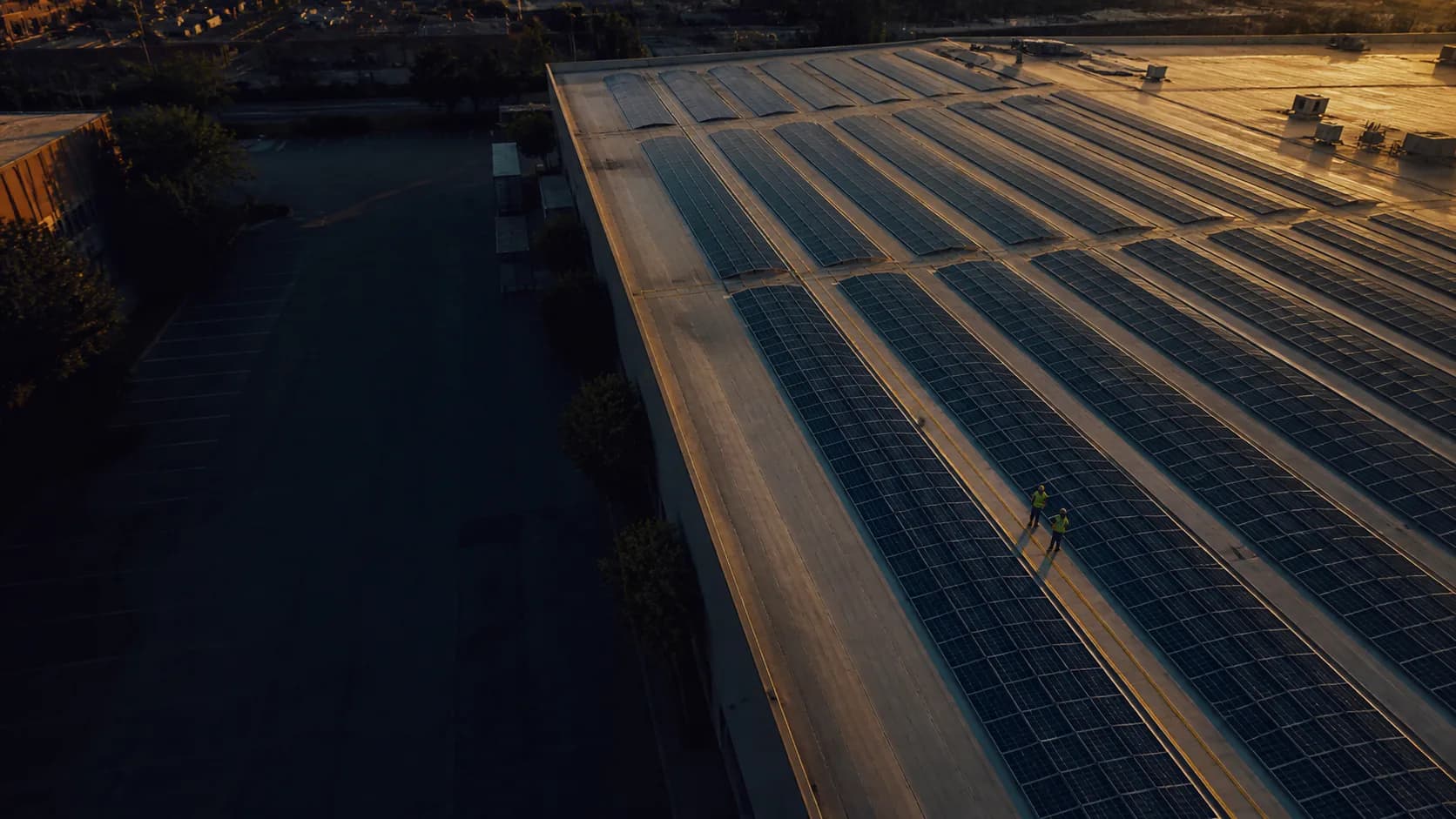
Healthy
501 systems running as they should — we keep checking.
Sol AI
Every supported brand on one screen. Sol AI keeps a live model of each system — location, weather, season — so it knows what the system should be producing right now, and says so when reality falls short. Faults come classified in plain terms with an estimated cost, and homeowners get told in words they use. Turn your install base into $10–25/month Solar Assurance plans; we charge you $1.50/system.
Per string
Sol AI works out what every system — and every string, the groups of panels wired together inside it — should be producing under today's weather, then compares that to what actually arrived. A system can be online, reporting, and still quietly missing a third of its production. That gap is what gets surfaced.
In dollars
A fault that reads “string 2 offline” means nothing to a homeowner and little to a dispatcher. Sol AI classifies the fault and attaches an estimated monthly cost, so a truck roll can be ranked against its own payback.
Plain language
Every diagnosis has a homeowner-readable version. It is what makes a Solar Assurance plan sellable. The customer sees what you caught and what you fixed, in words they use.
Economics
Your install base is already the asset. We charge $1.50 per system per month. The spread between that and what a Solar Assurance plan bills is the service business.
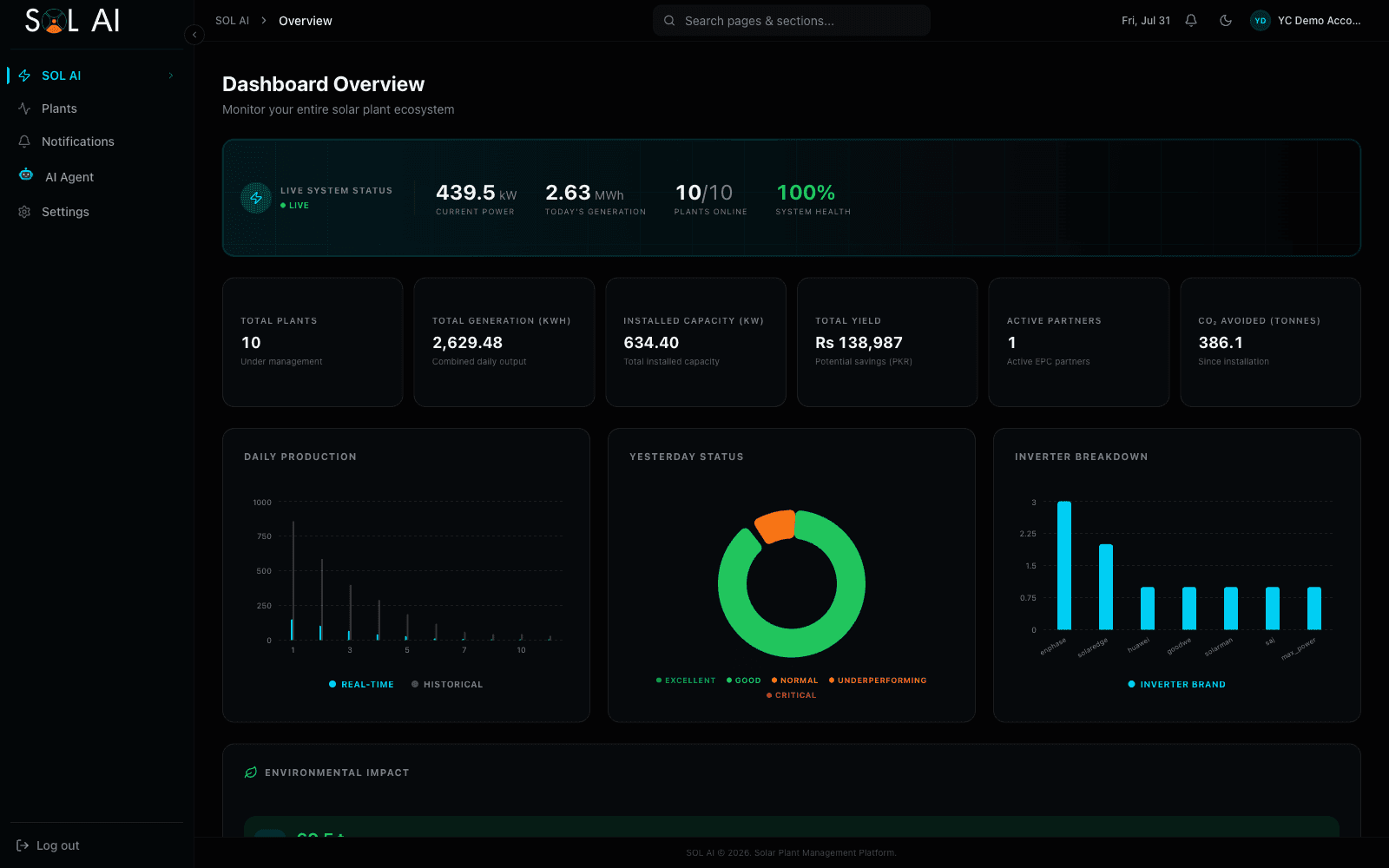
When something breaks
Not a wall of alarms — a short work queue. Every fault is classified in plain terms, carries a confidence score, and is ranked by what it's costing, so your team fixes the expensive things first.
Issues — sorted by cost
3 openDisconnected stringCedar Hollow Residence · string 2 of 3
About a third of production missing. Every status light: green.
Soiling suspectedGreenfield Warehouse
Gradual decline across all daylight hours — likely needs a cleaning.
Shading patternWillow Park Rooftop
Same-hours dip every afternoon — something new is casting a shadow.
Each diagnosis carries a confidence score and an estimated monthly cost, and closes with a recorded inspection outcome — confirmed, false positive, or fixed.
A 29-kilowatt residential system. One of its 3 strings disconnects. The manufacturer's app: green — the total still looks plausible. Sol AI's weather-adjusted baseline: a third of the system's production missing, flagged automatically. The homeowner would never have found it. Multiply by every roof you've ever touched. That's the service business hiding inside your install base.
Install-base economics
Solar Assurance revenue against monitoring cost, on the systems you have already installed.
400 systems → $96,000/year of Solar Assurance revenue against $7,200/year of Sol AI cost.
See the full calculator and the maths →
Selling the systems in the first place is a different problem. That is AI solar lead response, and the numbers behind both are on our audited proof page.
Weighing alternatives? See how Sol AI compares with Omnidian and with the Enphase app.
Service revenue
Every fault Sol AI finds in the systems you've installed becomes a customer call you get to make. You bill the visit and the repair at your own rates — the customer gets a working system and someone to thank.
Sol AI flags a fault
classified, and priced in plain terms
You call your customer
before they ever notice
“Please fix it.”
a known fault is an easy yes
Truck rolls, repair billed
your crew, your rates
System healthy again
and it's your name they thank
Pre-set to typical numbers — drag if yours differ:
Extra revenue you could be billing
+$10,000/month
$120,000 a year
10 repair jobs found for you each month
1,000 systems × 1% × $1,000 = $10,000 a month
Every market's numbers are different — drag the bars to match yours. What Sol AI does is find the work.
The service revenue is yours — we don't take a cut.
And that's only the repair engine — Solar AssuranceSolar AssuranceA simple monthly plan — $10–25 — you sell to homeowners. It means: someone is actually watching my solar system. We do the watching, you get the service call, and your brand is on every report — and most of that monthly line is yours.Customers who feel looked after renew, refer their neighbors — and hand you a closing line the other bid doesn't have: “every system we install is watched for its lifetime.” subscriptions add their own line. See the recurring math →
How it works
Every system you've installed already sends its data to a manufacturer's cloud. Sol AI reads all of them at once, works out what every system should be producing, and tells you — and your customer — only what matters.
Reads every system about every 11 minutes · translates every brand into one language
Healthy
501 systems running as they should — we keep checking.
String disconnected
Cedar Hollow Residence · 29 kW
Its own app still says green. A service call you get to bill.
Homeowner report
Plain English, your brand on it.
Sol AI
Reads every system about every 11 minutes · translates every brand into one language
Healthy
501 systems running as they should — we keep checking.
String disconnected
Cedar Hollow Residence · 29 kW
Its own app still says green. A service call you get to bill.
Homeowner report
Plain English, your brand on it.
Every brand speaks a different language. Sol AI translates them into one.
18brands supported · one dashboard
How it connects
Sol AI connects to each inverter manufacturer's cloud platform through its API, authenticated with an account credential or OAuth token you authorise once per brand. The inverter is already sending its data there; we read the same stream, on your behalf, across every brand at once.
Nothing is installed at a site. No data logger, no gateway, no local network configuration, no second device for a homeowner to unplug during a router reset. Bringing an existing install base online is a credential exchange rather than a truck roll, which is what makes adopting orphaned systems practical at all.
Sol AI checks each system roughly every ten minutes — a median of 11, measured across 55,268 gaps between readings. That is as fast as the manufacturers' own clouds publish; nothing installed on site would make them faster.
What we do not do: we do not speak Modbus TCP, IEC 60870 or OPC UA, and we do not deploy local protocol gateways or SCADA integrations. If you need direct on-site polling of utility-scale plant over an industrial protocol, we are the wrong tool. Better to say so now than during onboarding.
Brand coverage
Connect the portals you already use, and the systems you've commissioned land in one fleet view — whatever hardware is on the wall.













Next slot
Don’t see your brand?
FAQ
Sol AI is a monitoring platform that builds a digital twin — a live model — of every solar system an installer has put in, across every supported inverter brand, in one dashboard. Because the model knows what each system should be producing under today's weather, Sol AI can flag the gap when real output falls short, classify the fault with an estimated dollar cost, and explain it to homeowners in plain language. It currently watches 504 systems totalling 19.8 MW — 399 of them installed by other companies — checked roughly every 11 minutes.
A monthly service an installer sells to homeowners — typically $10–25/month — that says: someone is actually watching your system. Sol AI does the watching, checking each system roughly every 11 minutes against what it should be producing; the report carries the installer's brand, and the homeowner is told in plain language when something needs attention. Most of that monthly line is the installer's service revenue, and the customer relationship stays the installer's.
Sol AI supports 18 inverter brands: Enphase, SolarEdge, Tesla, SMA, Fronius, CPS, Sol-Ark, Generac, GoodWe, Sungrow, Huawei, Fox, Solis, Growatt, SolaX, Solarman, SAJ and MaxPower — every one of them lands in the same dashboard and the same Issues queue. See all 18 brands →
Yes — Enphase and SolarEdge are fully supported, alongside every other brand on the wall: connect the portal credential and the fleet shows up in the same dashboard. See the brand wall →
No. Sol AI connects to each inverter manufacturer's cloud platform through its API, using a credential you authorise once per brand. Nothing is installed at a site — no data logger, no gateway, no local network configuration — so bringing the systems you've already installed online is a credential exchange rather than a truck roll.
Sol AI reads production data through each inverter manufacturer's own cloud service, using a credential you authorise once per brand. That access is read-only: Sol AI watches output; it cannot send commands to an inverter, change its settings, or switch anything on or off. Revoke a credential in the manufacturer's portal at any time and the data flow stops with it.
Sol AI stores what monitoring needs: production and device readings, system details, and the contact information you choose to add for reports. Data travels over encrypted connections, is never sold or shared with third parties, and is used for one thing — running your monitoring. The platform runs on AWS, currently in the Asia-Pacific (Singapore) region behind Cloudflare's network; US data residency is planned as part of the US launch.
String-level monitoring reports the output of each individual string of panels rather than only the system total. It matters because a system with one dead string still reports plausible total production and shows no fault, so the failure can persist for months. In one case we documented, a 29 kW system ran with one of three strings disconnected for 22 days while the manufacturer's app showed green — a third of the system's production, missing, that only appeared when output was compared against a weather-adjusted baseline.
The systems keep producing but nobody is comparing their output against expectation. The homeowner still has the manufacturer's app, which reports what the inverter can see, but no one is watching for the failures that do not announce themselves — a dead string, a failing optimiser, encroaching shade. Because residential monitoring runs through the manufacturer's cloud API, another company can adopt those systems without a site visit.
By selling monitoring and Solar Assurance plans on systems they have already installed, typically $10-25 per home per month. The install base is already paid for, so the only new cost is the monitoring platform — Sol AI charges $1.50 per system per month — and the spread is recurring margin on completed work. A 400-system base at $20 per month is $96,000 a year against $7,200 of cost.
Monitoring finds the faults, and every fault is a customer call: you tell the homeowner what's wrong, they ask you to fix it, and you bill the truck roll plus the repair at your own rates. Sol AI finds the work and takes no cut of the service revenue. What it adds up to depends on how many systems you've installed, your fault rate and your market's prices — the service calculator on our homepage lets you do the math with your own numbers.
Modular Intelligence is the company behind Sol AI and Rae, founded by Mujtaba Raza. It was built inside Solar Citizen, a solar installation company operating across 11 cities in Pakistan, and its software has run that company's sales and service end to end since February 2026. It is now bringing the platform to US installers, starting in New York.